Health Sites Got The FAQ Rich Result Exception. Most Don't Qualify

When Google narrowed FAQ rich results in 2023, the exception list was specific: authoritative government sites and medical institution sites. Half of the wellness, supplement, and fitness brands we audit assume that includes them. It does not. Here is the line Google actually drew, who qualifies, and what the rest of the health and wellness category should do instead.
What Google actually said in 2023
Google’s announcement on August 8, 2023 used precise language: FAQ rich results would be retained only for “well-known, authoritative government and health websites.” Search Engine Land covered the rollout and clarified that this meant entity-level qualification: sites like Mayo Clinic, NHS, CDC, MedlinePlus, Cleveland Clinic, peer-reviewed medical journals, and gov-tld health agencies. The qualifier was authority of the entity, not the depth of the medical content on a given page.
The result is a cliff. A site qualifies or it does not. Domain rating does not move the line. Medical content depth does not move the line. A medically-reviewed wellness brand with a DR of 70 does not qualify. A 12-page county health department site with a DR of 25 does.

The eligibility checklist most health and wellness brands fail
In our experience auditing brands across functional medicine, supplements, fitness, mental health, women’s health, and adjacent wellness categories, almost none qualify. The pattern of failures is consistent. Here is the test we run during the SEO audit phase:
| Criterion | Likely qualifies | Does not qualify |
|---|---|---|
| Top-level domain | .gov, .nhs.uk, .who.int, official ministry domains | .com, .co, .health, .wellness |
| Entity type | Hospital, medical school, peer-reviewed journal, government health agency | Commercial brand, DTC supplement, wellness app, fitness platform |
| Editorial governance | Medical board oversight, named clinician reviewers with institutional affiliation | Internal medical advisor, no institutional affiliation |
| Established authority signals | Cited by other authoritative health sites at scale | Brand mentions, influencer features, press coverage |
| Funding and ownership | Public health, university-affiliated, regulatory body | VC-backed, private, founder-owned |
A clinically-credentialed wellness brand with a medical advisory board, peer-reviewed citations on every claim, and a Stanford-affiliated reviewer can be excellent and still not qualify under this framework. The test is institutional authority, not content quality.
Why this matters for commercial health and wellness SEO strategy
Two implications.
First, do not assume your FAQ schema is still earning rich results. We audit health-adjacent brands quarterly that ship FAQ schema with the explicit assumption that medical content qualifies them for the exception. What we find is that the schema continues to validate cleanly in Search Console while the dropdown never surfaces in the SERP, and the listing ends up indistinguishable from any other commercial result on the page.
Second, the AEO opportunity is genuinely larger for health than for most niches. Google’s AI Overviews lean conservatively in YMYL health queries. They cite authoritative sources but also pull from well-structured commercial sites that signal trust through schema, named authors with credentials, and direct citations to authoritative sources. FAQ schema feeds this directly. The shift for commercial wellness brands is not “FAQ schema is dead.” It is “FAQ schema is now an AI Overview citation lever, not a SERP rich result lever.”
We covered the broader pattern in the SEO playbook for health and wellness. The schema reallocation is one of several adjustments most commercial wellness brands have not made.
What commercial health and wellness sites should actually do
1. Confirm you do not qualify, then stop optimising as if you do
Run the eligibility checklist above. If any row is “does not qualify” (and for almost every commercial brand at least three rows will be), accept that the FAQ rich result exception does not apply. Stop the engineering work that assumes it does. We see this on supplement brands, fitness apps, mental health platforms, women’s health DTC, and functional medicine clinics most often.
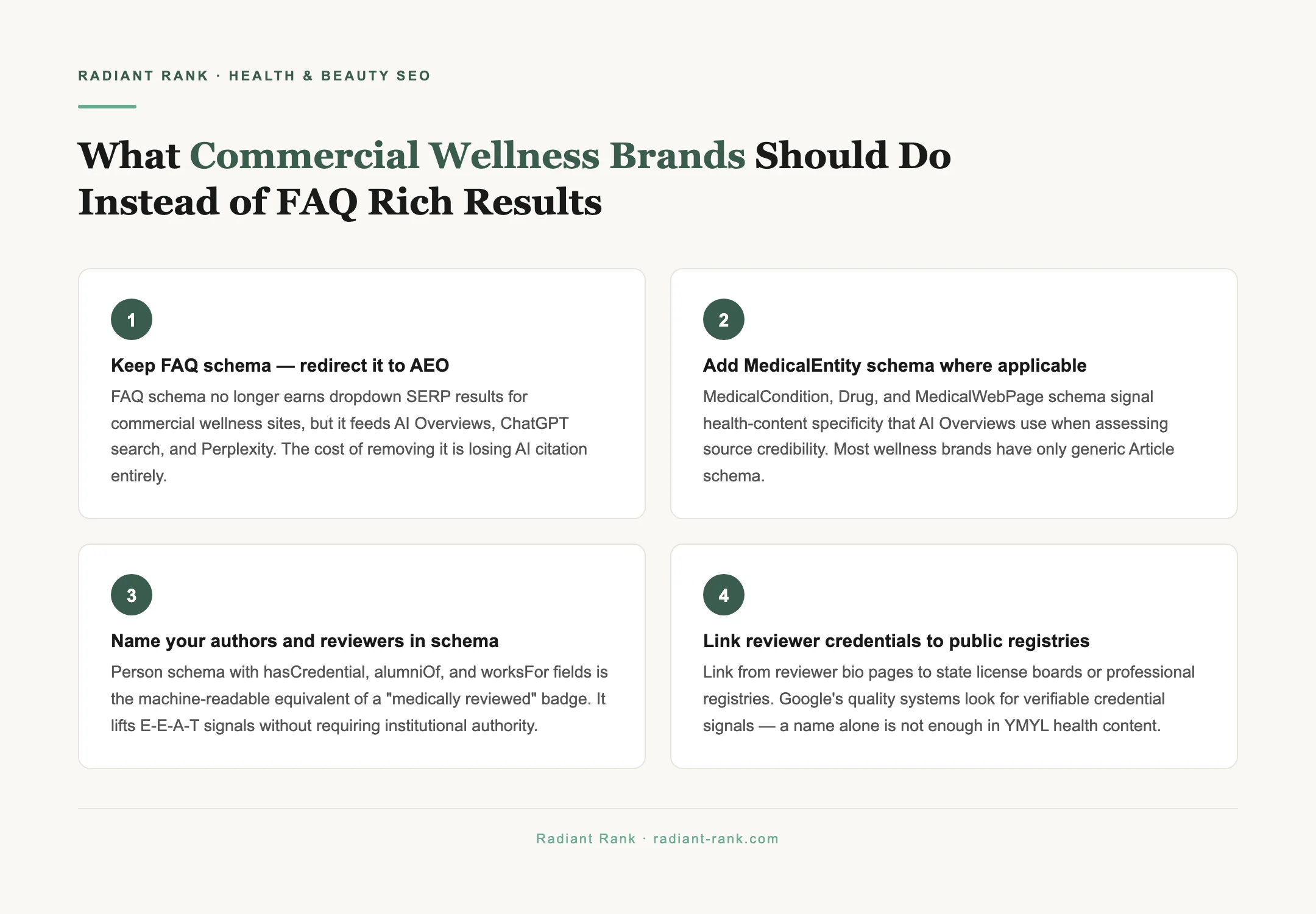
2. Redirect schema effort into MedicalEntity, MedicalCondition, and Drug schema where applicable
Health-adjacent commercial sites have access to a richer structured-data taxonomy than they typically use. MedicalEntity and its sub-types (MedicalCondition, Drug, Substance, AnatomicalStructure) signal medical-content specificity in a machine-readable format that AI Overviews use to assess source credibility for health queries. Configured correctly, this schema does more for commercial wellness AEO citation than another round of FAQ optimisation.
Specifically:
- MedicalCondition schema on educational pages about a specific health condition
- Drug schema on pages describing supplement compounds with structured contraindication data
- MedicalWebPage at the page-type level, with
medicalAudiencepopulated - Person schema with
hasOccupationon author bios for clinically credentialed reviewers. This is the structured equivalent of a “medically reviewed” badge
Most commercial wellness sites we audit have generic Article schema and FAQ schema. None have MedicalEntity-family schema configured. The latter is where the AEO gain is.
3. Strengthen author and reviewer credibility signals
E-E-A-T scrutiny is heaviest in YMYL health content. Google’s quality systems and AI Overview source ranking both lean on machine-readable authority signals: named authors, named medical reviewers, institutional affiliation, license numbers in Person schema, links to credential verification.
For a commercial wellness brand, this means:
- Author bio pages with full Person schema (
hasCredential,alumniOf,worksFor) - A “Medically reviewed by” line on every clinical claim, with the reviewer’s credentials in schema
- Link from reviewer pages to public credential verification (state license boards, professional registries)
We covered this in our breakdown of SEO for health platforms and in the wellness app SEO playbook. Credibility schema work is the strongest YMYL move available to commercial brands.
If your health or wellness brand is still optimising under the assumption that medical content qualifies for the FAQ exception, an audit is the place to start. Read the Radiant Rank pillar guide on health and wellness SEO for the full architecture.
If you want this audit done (eligibility verification, schema reallocation, credibility-signal mapping), it is the first deliverable of every Radiant Rank engagement.
FAQ
Does my wellness brand qualify for the FAQ rich result exception? Almost certainly not. The exception is institutional. A commercial brand on a .com domain, even with medical advisory board oversight, does not qualify. The exception covers government health agencies and major medical institutions: Mayo Clinic, NHS, CDC, peer-reviewed journals, and entities of equivalent institutional authority.
What if our medical advisory board includes Stanford or Harvard-affiliated clinicians? The clinicians are credibility signals for E-E-A-T and AI Overview source ranking, but they do not transfer institutional authority to your domain for the FAQ exception. The exception applies to the publishing entity’s authority, not to individual reviewers’ affiliations.
Should we still implement FAQ schema? Yes. The schema feeds AI Overview citation, ChatGPT search, and Perplexity, which is increasingly where YMYL health queries are answered. The cost of keeping FAQ schema enabled is zero. The cost of disabling it is losing AEO citation on the question content already on the page.