Health Platform SEO: How to Get Discovered Without Paid Ads

What health platforms are — and why they’re invisible to Google
Health platform SEO is the practice of optimising a health or wellness platform’s web presence so it appears in Google search results. It covers the technical setup, content strategy, and keyword targeting that make a platform discoverable to people searching for what it does — before they ever open an app store or pay for an ad.
Most health platforms are invisible to Google by default. The platform exists. The product works. But the website is thin — a download page, a features list, maybe a blog with three posts published two years ago. Google can’t index what isn’t there. Users who don’t already know the brand name can’t find it through search.
This isn’t a niche problem. Rock Health’s funding reports consistently show that health tech attracts significant investment, yet user acquisition remains the top challenge for early-stage platforms. The product gets built. The discovery layer doesn’t.

The difference between app store discovery and web search ranking
App stores and Google are separate ecosystems. They surface content differently, reward different signals, and serve different user behaviours.
When someone opens the App Store or Google Play, they’re already in buying mode. They know they want an app. They’re choosing between options. App store optimisation (ASO) helps at that stage — title, screenshots, keywords within the store, and reviews.
Web search comes earlier. A user types “meal planning app for PCOS” or “mental health journaling tool” into Google. They’re researching. They haven’t decided to download anything yet. This is the highest-value moment in the discovery funnel — and app stores don’t participate in it.
Platforms that rank in Google web results capture users before the purchase decision forms. That’s a different kind of traffic from app store installs, and it compounds. An article that ranks for “best wellness app for night shift workers” keeps delivering visitors for months without additional spend.
Google Search Central confirms that indexable web content — structured, crawlable HTML pages — is the foundation for organic discovery. An app listing is not a substitute.
Keyword research for health platforms: who’s searching and what queries they use
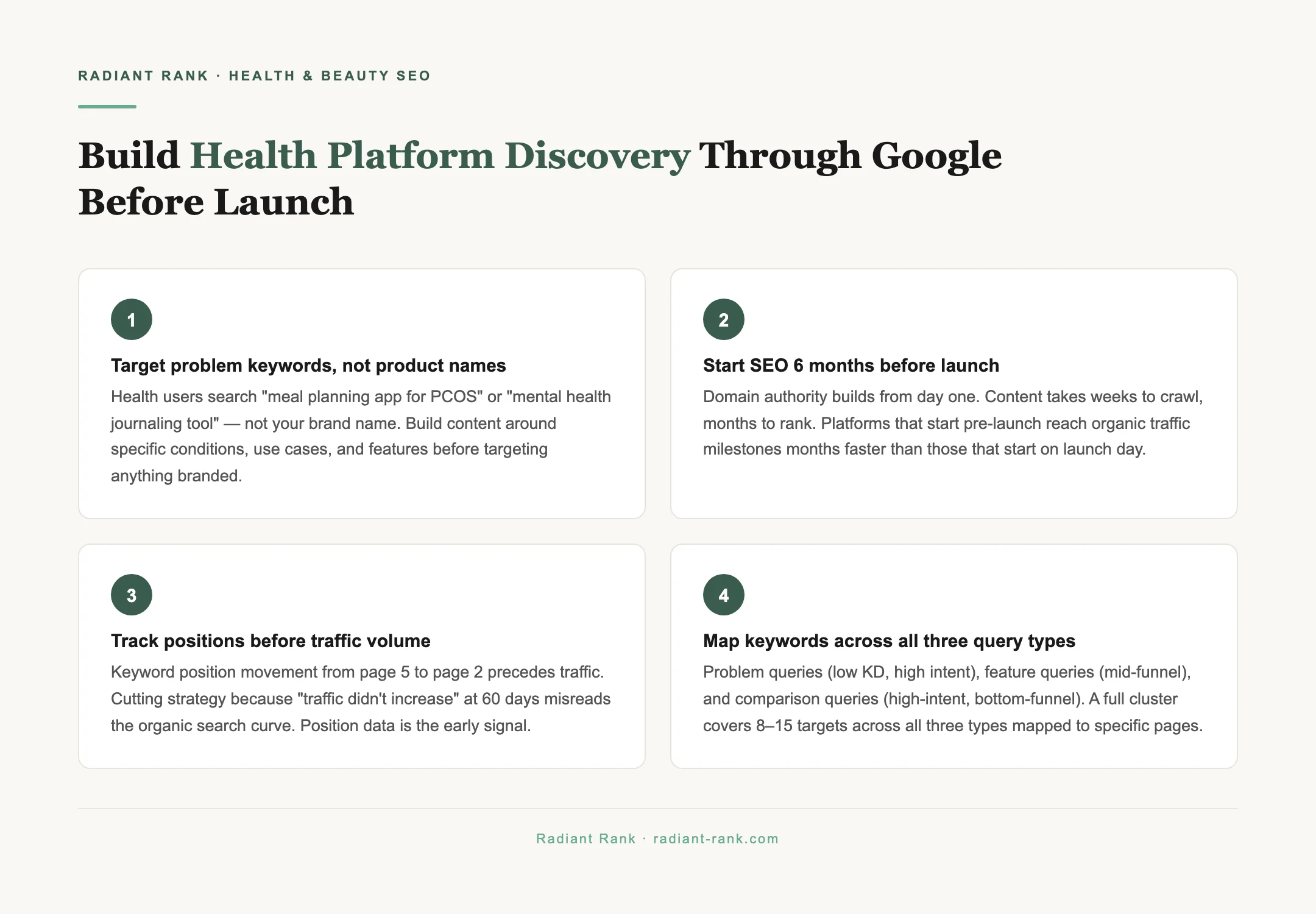
Health platform users don’t search for product names. They search for problems, conditions, and use cases.
“Meditation app for anxiety” gets searched by people who haven’t chosen a platform yet. “HRV monitoring app for runners” is searched by athletes who want a specific feature. “Period tracking app without data sharing” is searched by privacy-conscious users. These are the queries that health platform SEO targets.
The keyword structure falls into three types:
Problem queries. Searches centred on a symptom, condition, or challenge. High intent, often long-tail, usually KD under 15. Examples: “app for managing chronic fatigue,” “nutrition tracker for eating disorder recovery.”
Feature queries. Searches for a specific capability. Mid-funnel. Examples: “sleep tracker with smart alarm,” “wellness app that syncs with Apple Health.”
Comparison queries. Searches evaluating options. Bottom-of-funnel. Examples: “best mental health app alternatives,” “nutrition app vs dietitian.”
The health and wellness niche has a structural advantage here. Most platforms haven’t built content targeting these queries. According to CB Insights health tech data, the sector sees substantial new platform launches each year, but content marketing adoption lags significantly behind traditional SaaS verticals. That creates space.
A solid keyword cluster for a health platform will include 8-15 primary targets across all three query types, mapped to specific pages.
Content strategy: how a blog becomes a platform discovery driver
A blog isn’t a publishing exercise. It’s a traffic engine, if it’s built around the right queries.
Each article should target one specific keyword with clear search intent. The article answers that query better than anything else currently ranking. Over time, a cluster of related articles builds topical authority — Google starts to associate the domain with the health or wellness topic the platform serves.
For health platforms, the most effective content types are:
Use-case guides. “How to use a wellness app for shift workers” or “how to track macros with a chronic illness.” These match the exact way health platform users search.
Condition-specific pages. Articles built around a health condition and how the platform helps manage it. High intent, low competition in most niches.
Comparison pages. “Platform X vs Platform Y” pages capture users at the decision stage. They’re straightforward to rank because most platforms don’t build them.
The Health and Wellness SEO Guide covers content structure in more depth — including how to build a cluster from scratch when starting with zero domain authority.
One rule applies across all content types: every page must target a specific query. “Our blog” as a general publishing destination doesn’t rank. A page built to answer “how to improve sleep quality with data tracking” ranks.
Pre-launch timing: when to start SEO (answer: before you launch)
This is the most common timing mistake in health platform SEO. Platforms wait until after launch to start organic search work. Then they wonder why traffic doesn’t arrive.
SEO compounds over time. Domain authority builds from the moment Google first indexes the site. Content takes weeks to crawl and months to rank. The platforms that start six months before launch are ranking by the time they go live. The ones that start on launch day are still waiting six months later.
The pre-launch window is the best time to build because there’s no revenue pressure. Content can be created, indexed, and accumulating authority before the first user signs up.
The minimum pre-launch SEO setup for a health platform:
- Core pages indexed and crawlable (home, about, feature pages)
- 3-5 blog posts targeting primary keyword cluster
- Technical foundation: canonical tags, sitemap, structured data
- Google Search Console connected and verified
That’s enough to start building. It doesn’t have to be complete. It has to exist.
The wellness app industry has seen this pattern play out. Platforms that treat SEO as a day-one function, not a post-launch add-on, reach organic traffic milestones months faster.
Measurement: which metrics matter for health platforms
Traffic volume is the wrong primary metric for early-stage health platform SEO.
Early SEO generates impressions before it generates clicks. A page indexing and appearing in Google results for 30 searches per month is working — it just needs time to move up the rankings. Cutting the strategy because “traffic didn’t increase” after 60 days misreads how organic search works.
The metrics that matter, in order:
Indexed pages. Is Google finding and indexing the content being published? Check this in Google Search Console under Coverage. If pages aren’t indexed, nothing else matters.
Keyword positions. Are target keywords moving from positions 20-50 toward positions 1-10? Position movement precedes traffic. Track the 8-15 primary keywords from the research cluster.
Organic click-through rate (CTR). Once pages appear in results, are users clicking? A CTR below 2% on informational content suggests title tags or meta descriptions need revision.
Organic signups or downloads. At the platform level, the metric that matters is whether organic traffic converts to users. This requires UTM tracking or Google Analytics 4 event tracking connected to your conversion events.
Monthly reporting against these four metrics gives an accurate picture of whether the strategy is working. Traffic volume becomes meaningful around month 4-6, once keyword positions have stabilised.
FAQ
How do health apps get found on Google?
Health apps get found on Google through web content — blog posts, landing pages, and service pages optimised for the search terms their users type before they ever open an app store. Google indexes websites, not apps. The platforms that rank build content around specific problem and use-case queries, then earn discovery through organic search over time.
Can a health platform rank without backlinks?
Yes, especially in low-competition niches. Platforms targeting specific health conditions, wellness practices, or professional use cases often face KD scores under 20. Well-structured content with clear topical focus can rank with minimal or no backlinks, particularly in the first 6-12 months.
What’s the difference between app store SEO and web SEO?
App store SEO optimises your listing inside the App Store or Google Play. Web SEO optimises your website to appear in Google search results. They serve different users at different stages. Web SEO captures the user at the research stage — before they’ve decided to download anything. That’s the higher-value moment.
Health platforms that build their SEO foundation early capture users at the point of decision, before the ad spend starts. If you’re building in the health or wellness space, health platform SEO is the acquisition channel that compounds. Our wellness app SEO service is built specifically for platforms like yours — keyword research, content strategy, and technical setup, without the generalist agency overhead.