SEO for Health Brands: Stop Ranking for the Wrong Keywords

Most wellness brands know they need SEO. They’ve tried it — hired a freelancer, signed with an agency, published a few blog posts with no keyword strategy. Nothing happened. So they went back to ads.
The problem isn’t SEO. It’s that most health brands target the wrong searches entirely.
[EXPERIENCE: I’ve audited supplement brands that ranked on page one for their own product name and nothing else. Founders thought that was working. It wasn’t. Brand searches don’t grow your business. Buyer searches do.]
This post is about health brand SEO done right — targeting the searches that exist before someone knows your brand exists.

The Health Buyer’s Journey: What They Actually Search For
Health buyers follow a predictable search path: problem first, then ingredient, then brand. Someone with poor sleep doesn’t search for your melatonin gummies. They search “why can’t I sleep” or “natural sleep support.” Then they look up “magnesium for sleep.” Then — maybe — they find you.
That three-stage path is your keyword map. Most health brands only show up at stage three. By then, the buyer has already been educated by someone else.
The brands that win in organic search are present at every stage. They rank for the problem searches. They dominate the ingredient searches. And by the time a buyer reaches brand-level searches, that brand feels familiar.
This isn’t complicated. It’s just rarely done with this kind of intention.
The Mistake: Chasing Brand Awareness Searches, Not Buyer Intent
Brand awareness keywords — “best wellness brand,” “top supplement companies,” “natural health products” — get searched. But the people searching them are not ready to buy. They’re browsing.
Buyer intent keywords are different. They sound like:
- “ashwagandha for cortisol”
- “magnesium glycinate vs oxide”
- “collagen peptides for joint pain”
- “sleep supplement without melatonin”
These searches have low volume. That’s why most SEO agencies skip them. But the person typing “ashwagandha for cortisol” is much closer to a purchase than the person typing “wellness trends 2026.”
Low-volume, high-intent keywords convert. High-volume, low-intent keywords generate traffic reports.
If your SEO strategy is built around traffic volume, you’re optimising for the wrong metric. The right metric is the proportion of organic visitors who could plausibly buy from you.
Read the Health and Wellness SEO Guide for a full breakdown of keyword intent mapping across the buyer journey.
Ingredient SEO: The Opportunity Most Health Brands Miss
Ingredient keywords are the biggest untapped area in health brand SEO. They sit right in the middle of the buyer journey — after the problem search, before the brand search.
When someone searches “ashwagandha benefits” or “lion’s mane cognitive function,” they are actively researching what to buy. They have a problem. They’ve heard about an ingredient. They want to understand it before they commit.
If your brand doesn’t show up for those searches, a health publication does. Or a competitor. And that competitor earns the trust you needed.
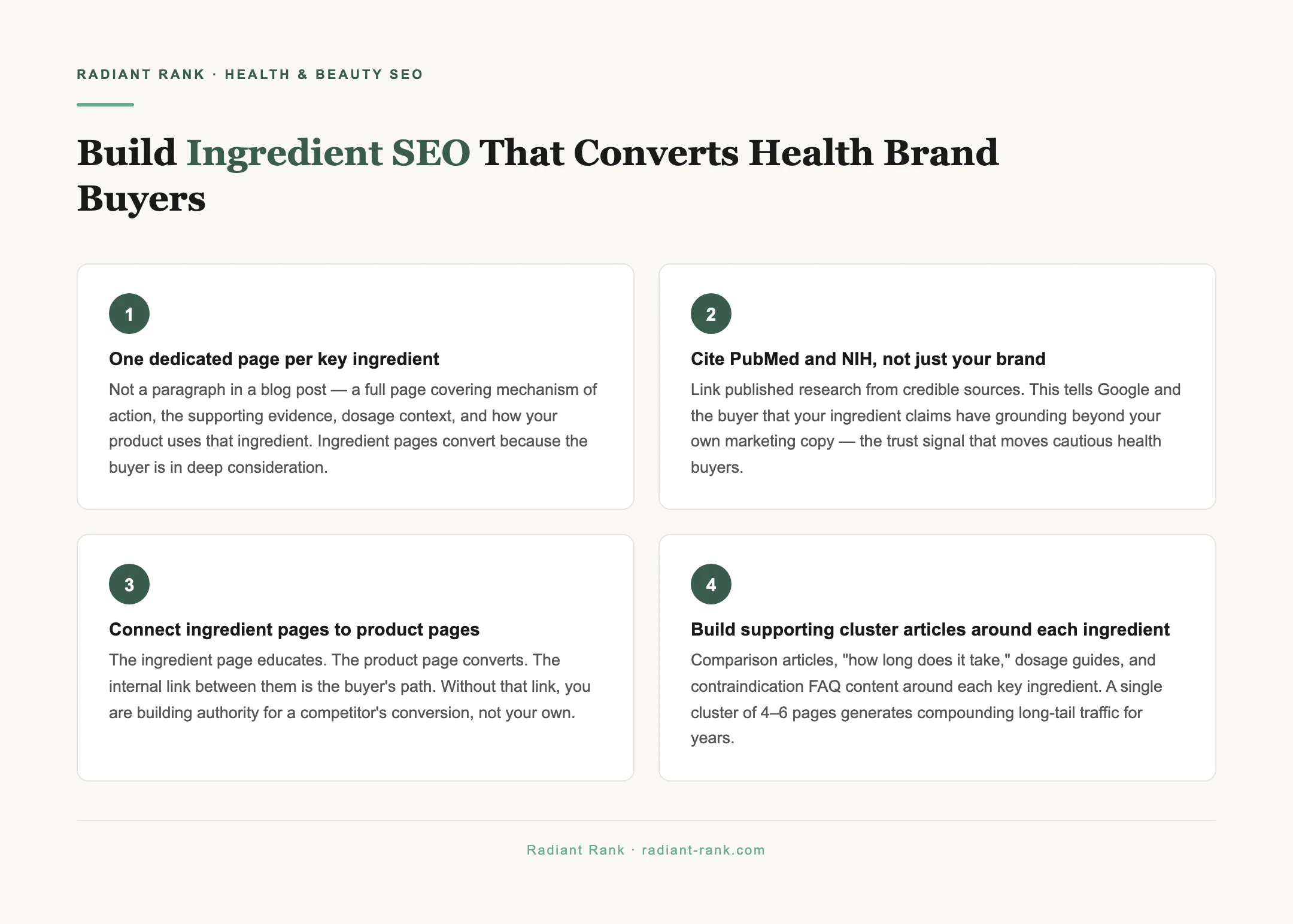
Building ingredient SEO means:
- One page per key ingredient. Not a paragraph in a blog post. A dedicated page covering the mechanism, the evidence, the dosage context, and how your product uses that ingredient.
- Citing real research. Reference published studies from sources like NIH’s National Library of Medicine. This signals to Google and to buyers that your claims have grounding.
- Connecting ingredient pages to product pages. The ingredient page educates. The product page converts. The link between them is the buyer’s path.
Ingredient pages consistently rank for long-tail queries that generalist agencies never target. They also outperform blog posts in conversion because the searcher is already deep in the consideration stage.
Authority Signals for Health Brands: Reviews, Credentials, and Third-Party Sources
Google evaluates health content differently to most other categories. It applies heightened scrutiny under its E-E-A-T guidelines — Experience, Expertise, Authoritativeness, Trustworthiness.
For health brands, this has specific implications.
Reviews matter more than in other niches. A supplement buyer who can’t verify a claim will look to other buyers. Volume and recency of reviews both influence how Google treats your site. More importantly, they influence whether a cautious buyer converts.
Credentials belong on the page. If a formulation was developed with a registered dietitian, say so. If your founder has clinical training, say so. If your products are third-party tested, say so — and link to the certificate. These aren’t nice-to-haves. They are ranking factors in a category where trust is the purchase barrier.
Third-party mentions build authority. Press coverage, affiliate content from health journalists, and links from recognised health publications all signal to Google that your brand exists beyond your own site. A backlink from a general blog directory means very little. A backlink from a health research aggregator means a great deal.
None of this requires a large budget. It requires intention and patience.
Content Architecture for Health: Topical Clusters Around Ingredients and Benefits
A topical cluster is a group of related pages built around a central theme. In health brand SEO, the most effective clusters are built around ingredients and benefits — not products.
Here’s what a cluster looks like in practice:
Central page (pillar): Ashwagandha for stress — a comprehensive guide covering the research, typical doses, who it’s for, and what to look for in a supplement.
Cluster pages (supporting):
- Ashwagandha vs Rhodiola for stress
- How long does ashwagandha take to work?
- KSM-66 vs Sensoril: which ashwagandha extract is more effective?
- Can you take ashwagandha every day?
Each cluster page links back to the pillar. The pillar links to the product. The product page links to reviews and certifications.
This architecture does two things. It tells Google that your site has genuine depth on this topic. And it catches buyers at every question they might have along the way.
Building clusters takes time. But a single well-built ingredient cluster — four to six pages — can generate consistent organic traffic for years without ongoing ad spend.
Building Trust in a Low-Trust Space: Compliance and Transparency
Health buyers are careful. They’ve been misled before. They’ve bought supplements that didn’t work, followed wellness advice that wasn’t grounded, and paid for programmes that overpromised.
Your SEO content is also your trust-building content. These two goals should never be in conflict.
On health claims: the FTC’s guidance on health product claims is clear. You can make structure/function claims (“supports healthy cortisol levels”). You cannot claim to diagnose, treat, cure, or prevent a disease. This isn’t just a legal requirement — content that overpromises performs worse in search because it generates high bounce rates from buyers who recognise hype.
On transparency: publish your formulation rationale. Explain why you chose your ingredient forms and dosages. Link to the research behind them. Disclose what your products are not for. Buyers who find this kind of copy will trust you more than they trust brands that lead with superlatives.
This kind of copy also ranks better. Google’s quality raters are trained to look for content that demonstrates real knowledge. Content that hedges appropriately, cites sources, and avoids exaggerated claims reads as authoritative.
Frequently Asked Questions
Can I use health claims in my SEO content?
You can make structure/function claims without FDA approval, but you cannot claim to diagnose, treat, cure, or prevent any disease. The FTC requires that all health claims be truthful, not misleading, and backed by competent evidence. Stick to what clinical research supports, and always include standard disclaimers.
What’s the difference between health brand SEO and wellness brand SEO?
The distinction is mostly in search vocabulary and buyer intent. Health brand SEO targets symptom-led searches (“low energy,” “sleep problems”). Wellness brand SEO leans toward lifestyle and prevention searches (“adaptogens for stress,” “morning routine”). Most brands need both. The strategy should reflect where your actual buyers start their journey.
How do I rank for ingredient keywords?
Build one dedicated page per key ingredient. Cover the mechanism of action, the supporting evidence, the dosage context, and how your product uses it. Link to clinical sources like PubMed or NIH. Then build supporting content around it — related benefits, comparison articles, and FAQ content. Ingredient pages rank best when they’re specific, sourced, and connected to a topical cluster.
If your organic traffic is flat or drawing the wrong visitors, the issue is usually keyword targeting — not effort. The path forward is built around your buyers’ actual search behaviour: the problems they research, the ingredients they investigate, the questions they ask before they trust a brand enough to buy.
The wellness brand SEO service at RadiantRank is built for exactly this. We handle ingredient cluster strategy, E-E-A-T optimisation, and compliant content architecture — so your site earns the visibility it deserves with buyers who are already looking. Start with a look at what health brand SEO looks like in practice, or get in touch to talk through where your current strategy is leaving traffic on the table.
Looking for a broader foundation? Start with SEO for health and wellness for the full strategic overview.