How Long Does Health & Beauty SEO Take to Show Results?

Health and beauty SEO takes longer than most other niches. The honest range: first ranking movement in months 2–4 on established sites, first revenue in months 6–9, and full compounding from month 12 onward. New domains add roughly 3 months on top of that.
This post is the timeline I wish every wellness founder saw before they signed a 12-month SEO contract. No promises, no hedging — just what actually happens, what shortens it, and what makes it drag.

Why Health and Beauty SEO Is Slower Than Other Niches
Google classifies health and beauty content as YMYL — Your Money or Your Life — and applies stricter quality evaluation. That isn’t marketing copy on Google’s part. Their public quality rater guidelines name the category explicitly.
In practice, three things slow you down:
- New domains face more scrutiny. Google doesn’t assume your YMYL site is trustworthy until you prove it. Proof comes from named experts, third-party citations, consistent publishing, and time.
- Buyer journeys are longer. A skincare buyer might research a single ingredient for six weeks before purchasing. Even when you rank, conversion takes longer to register than in low-consideration categories.
- Authority signals accumulate slowly. Press mentions, ingredient citations, reviewer quotes from registered dietitians — these are earned over months.
If your previous agency pitched “results in 90 days,” this is why it under-delivered. The math doesn’t work for YMYL.
The Realistic Timeline, Month by Month
Months 1–3: Indexing and Technical Foundation
What’s happening: site audit, technical fixes, YMYL compliance pass, schema deployment, keyword map, first authority article. Indexation expands. Crawl errors clean up. Authors get proper bios.
What you’ll see: more pages indexed in Search Console, fewer crawl errors, possibly minor impression growth on long-tail queries you weren’t targeting. No revenue impact yet.
Common founder feeling: “Is anything happening?” Yes — the foundation that everything else compounds on.
Months 3–6: First Ranking Wins
What’s happening: 2–4 published pieces per month, internal linking dense across the cluster, on-page optimisation on existing PDPs, before/after photo SEO if you’re in beauty.
What you’ll see: 3–5 buyer-intent keywords moving from page 3 or 4 into page 2. One or two starting to flirt with page 1 positions. Traffic on long-tail queries you haven’t directly targeted. First trickle of organic-attributed conversions, usually low single digits.
This is the phase where most generalist agencies start declaring victory based on impressions. Don’t. Impressions aren’t revenue.
Months 6–9: Revenue Begins
What’s happening: authority signals have accumulated, internal cluster links are dense, ingredient pages and problem-led posts are ranking on page 1 or 2 for the commercial keywords you actually built around.
What you’ll see: 80–150 organic sessions per month on a healthy growth trajectory, first inbound enquiries or DTC sales attributable to organic search, and the keyword set you targeted in month 1 starting to show meaningful position movement.
For an established RadiantRank client on the Health and Wellness SEO Audit, this is typically where organic revenue starts to exceed the retainer.
Months 9–12: Compounding
What’s happening: refresh cycle on early posts, expanded keyword targeting based on what’s already ranking, earned mentions or press citations starting to land, schema and rich results stable.
What you’ll see: 200–500+ organic sessions per month for most established brands, multiple page 1 rankings, AI Overview citations starting to appear, and a category-relevant share of voice that wasn’t there before.
Month 12+: The Phase Generalists Never Reach
Compounding is real. The same publishing cadence now produces meaningfully more output because each new post enters a denser internal link graph and a category Google already trusts.
This is also where most brands that bailed at month 4 wish they hadn’t.
What Shortens the Timeline
Some inputs genuinely compress the curve. Others just feel like they should.
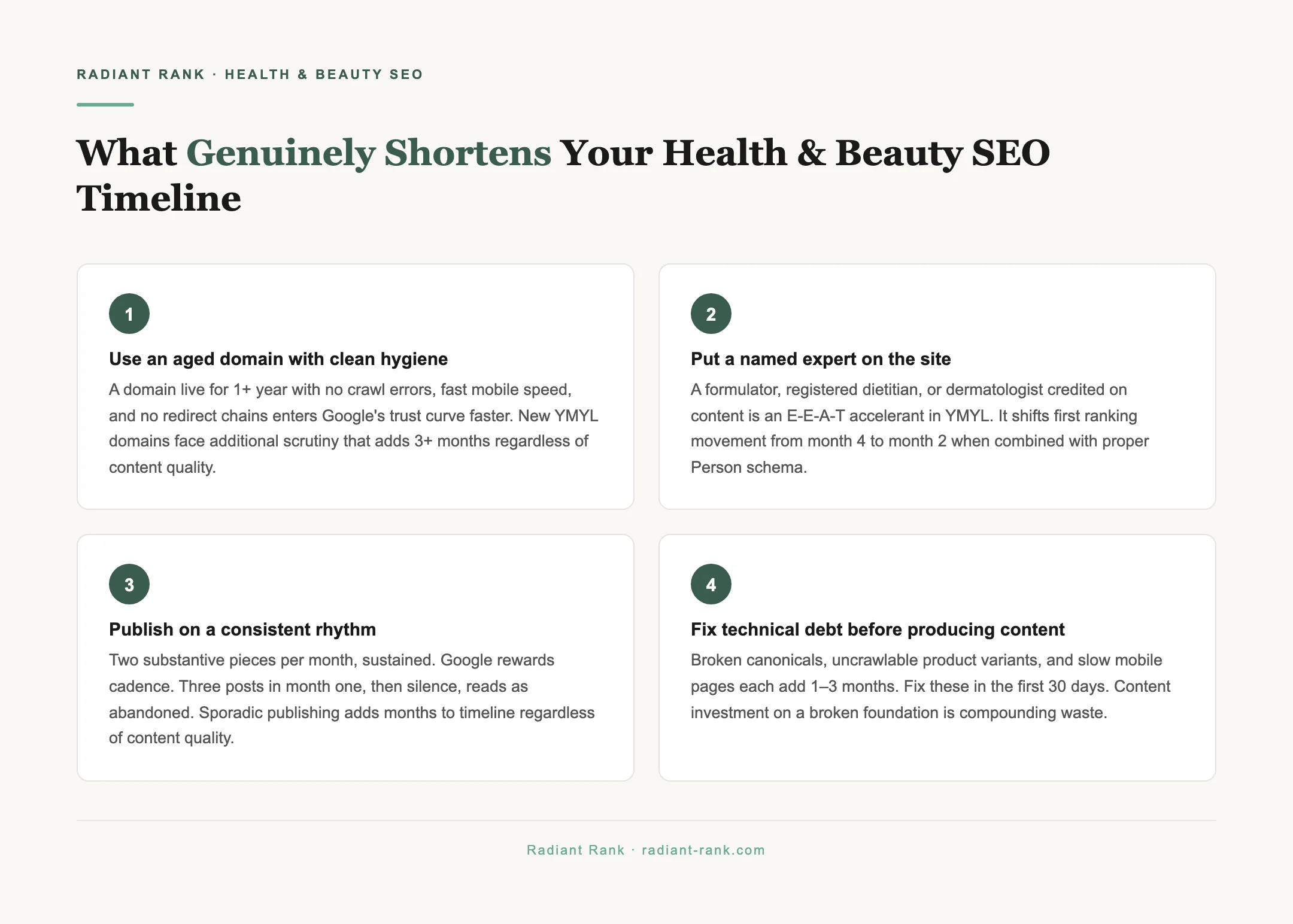
Genuinely shortens results:
- An aged domain (1+ year live) with clean technical hygiene
- An existing review base that signals product-market fit to Google
- A named expert on staff (formulator, registered dietitian, dermatologist) — E-E-A-T signal accelerates trust
- Pre-existing press mentions or backlinks from credible health publications
- A clear ingredient story that lends itself to ingredient-cluster content
- Publishing cadence of at least two substantive pieces per month, sustained
A site that has all six of those usually sees first ranking movement in months 2–3 instead of 4. That’s a real acceleration.
Doesn’t shorten results, despite the hype:
- Buying backlinks (Google ignores or penalises most of them; in YMYL they’re especially flagged)
- Mass-producing AI content (Google’s helpful-content updates have repeatedly suppressed thin AI output, especially in YMYL)
- “SEO PR” packages with low-authority mentions
- Bigger keyword target lists (broader ≠ faster; focused beats broad in this category every time)
What Lengthens the Timeline
The realistic drags. Most are fixable, but each one adds months.
- Technical debt. Broken canonicals, uncrawlable variants, mobile speed problems, redirect chains. Each adds 1–3 months to first ranking movement.
- Shallow or missing author bios on YMYL pages. Google’s quality raters look for them by name. No real author = capped E-E-A-T score.
- FTC-noncompliant claim language. Sites with disease claims or unsupported superlatives get held back at quality review even when other signals are strong.
- Inconsistent publishing. Three posts in month one, none for two months, four in month four. Google rewards rhythm. Sporadic publishing reads as abandoned.
- A new domain with no review base, no expert, and no press. Adds 3–6 months on top of the standard timeline. This is the hardest scenario, but it’s also the most common — and it’s still very doable, just slower.
If you want a sharper sense of the playbook that goes with this timeline, the 2026 SEO playbook for health and beauty brands breaks down what to do in each window.
Setting Expectations Honestly
The brands that succeed organically here understood the curve before they signed. They didn’t expect month-three revenue, didn’t bail in month four, and showed up in month seven with rankings that started to compound. Not because they were patient — because someone told them upfront what the curve actually looked like.
Frequently Asked Questions
How long does SEO take for a health and beauty brand?
Established sites: 2–4 months for first ranking movement, 6–9 months for revenue. New domains: 9–12 months for revenue. There are no shortcuts in YMYL.
Why is health and beauty SEO slower than e-commerce SEO in general?
YMYL classification, longer buyer journeys, and slower-accumulating authority signals. Compensated by being more durable once it lands.
Can I rank a new health brand in under 6 months?
On very low-competition long-tail keywords, sometimes. On commercial keywords that drive revenue, almost never. Treat any contrary promise as a warning.
If you want to know what the actual curve would look like for your domain — established vs new, current technical state, existing authority signals — that’s exactly what health and beauty SEO at RadiantRank diagnoses in month one. Real numbers, your domain, before you commit to anything longer.
For the strategic playbook that pairs with this timeline, read the 2026 SEO playbook for health and beauty brands.