SEO for Health and Beauty Brands: A 2026 Playbook
SEO for health and beauty brands isn’t generic SEO with prettier images. It’s a YMYL category — Your Money or Your Life, Google’s label for content that can affect health, finances, or safety — and Google applies heavier quality scrutiny to every page. If your strategy doesn’t account for that, you’ll publish a lot and rank for very little.
This playbook is for founders and marketing leads at supplement, skincare, wellness app, and beauty brands. It covers how the category actually differs from generic SEO, what to prioritise in months 0–3, 3–6, and 6–12, and the practical decisions that separate brands that compound organic revenue from brands that quietly give up after twelve posts.

How Health and Beauty SEO Differs From Generic SEO
Most agencies treat your site the same as a SaaS company or a furniture brand. That’s the first problem. Google doesn’t.
YMYL applies. Google’s quality rater guidelines name health and beauty explicitly. Pages that influence health decisions get evaluated more strictly for E-E-A-T — Experience, Expertise, Authoritativeness, Trustworthiness. You can’t fake it with stock photos and a generic “About” page.
Ingredient claims sit under the FTC’s microscope. The FTC’s dietary supplement advertising guide requires competent and reliable scientific evidence behind every claim. Structure/function claims are fine. Disease claims will get you in trouble — and overpromised copy also performs worse organically because it generates bounce.
Before/after photo SEO is its own discipline. Image search drives meaningful traffic in beauty especially. Filenames, alt text, ImageObject schema, and the wording around each photo all matter. Skin transformation photos with sloppy alt text (“amazing results!”) get under-indexed and risk FTC scrutiny. The same photos with descriptive, restrained alt text (“week 4 use of retinol serum on combination skin”) rank.
Retail vs DTC keywords don’t overlap as neatly as they look. A DTC supplement brand needs ingredient education, review-rich PDPs, and quiz/funnel pages. A retail-distributed brand needs where-to-buy pages, distributor locators, and category-authority content that wholesale buyers find. The keyword overlap is maybe 40%. Most agencies build the DTC side and ignore the rest.
[EXPERIENCE: In our work with wellness brands, the brands that scale organic revenue don’t have a “content strategy.” They have an ingredient strategy, a retail strategy, and a transformation-story strategy. Three separate maps that touch each other but each have their own logic.]
Months 0–3: The Foundation Phase
The first 90 days aren’t about ranking. They’re about removing what’s blocking ranking and putting what Google needs in place.
Priorities, in order:
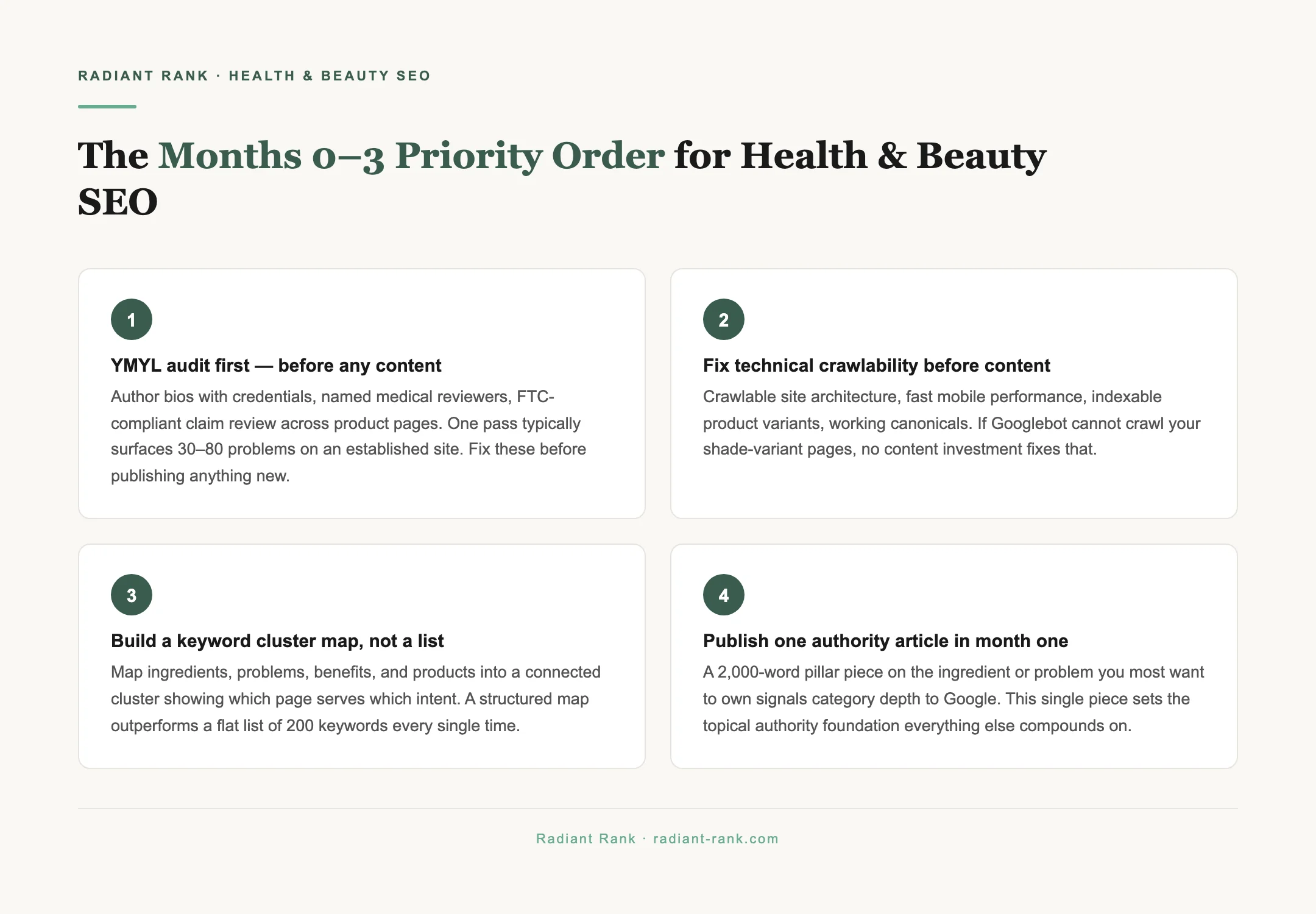
- YMYL audit. Author bios with credentials on every health-claim page. Medical or formulator reviewer named where appropriate. FTC-compliant claim review across product pages and blog posts. This single pass usually surfaces 30–80 problems on an established site.
- Technical fixes. Crawlable site architecture, fast mobile performance, indexable product variants, working canonicals. If Googlebot can’t crawl your shade-variant pages, no amount of content fixes that.
- Schema. Product, Review, AggregateRating, FAQ, Article, and ImageObject schema where appropriate. Health and beauty buyers compare obsessively — rich result eligibility shifts CTR meaningfully here.
- Keyword cluster architecture. Map your ingredients, your problems, your benefits, and your products into a connected cluster. Not a flat list of 200 keywords — a structured map showing which page serves which intent.
- One authority article. A 2,000-word pillar piece signals to Google that this site has depth in the category. Pick the ingredient or problem you most want to own and build it properly.
You won’t see traffic move in months 0–3. You will see indexation improve and crawl coverage clean up. That’s the foundation everything else compounds on.
Months 3–6: First Ranking Wins
Now the work shifts from foundation to deliberate ranking pursuit.
Publish on a real rhythm. Two to four pieces per month, each targeting a specific keyword cluster. For health and beauty, that usually means: one ingredient-deep piece, one problem-led piece, one comparison or “vs” piece, and one credibility piece (clinical study summary, expert interview, behind-the-formulation post).
Build internal links with intent. Every new piece should link to your homepage with a contextual anchor, link to your most relevant service or product page, and link to two existing posts. If you’re not sure how this looks in practice, our SEO for health brands post breaks down ingredient-led cluster structure.
Track the right keywords. Don’t chase impressions. Chase position movement on the 15–25 buyer-intent keywords that match the products you actually sell. Most brands at this stage start to see one or two of those move from page 4 or 5 into page 2 territory.
Fix before/after photo SEO across the existing site. Compress to WebP, rewrite alt text, add ImageObject schema, and audit any copy near transformation photos for prohibited claim language. Beauty brands especially see image search traffic respond inside this window.
Months 6–12: Compounding Revenue
This is the phase generalists never reach with health brands because they gave up around month four. The compounding starts here.
Topical authority becomes real. Google has now seen your site publish consistently in your category with citable evidence. Internal cluster links are dense. Rankings on related long-tail keywords start to appear without you targeting them directly.
Review and refresh. Audit the posts you published in months 0–6. Update stats, expand thin sections, add new schema, refresh any FAQ that’s now outdated. Refreshed pages often outperform new ones in this phase because they already have indexation history.
Press and citations. By month 8–9, you should have enough credible category content to pitch health journalists, ingredient researchers, and wellness publications. Earned mentions in trusted health outlets compound on the topical authority you’ve already built.
Revenue follows. For most of the brands we work with on the Health and Wellness SEO Audit, the period between month 6 and month 12 is where SEO starts paying for itself — not just generating sessions, but generating revenue that exceeds the retainer.
If you’re trying to model when that point actually arrives for your situation, read how long health and beauty SEO takes to show results for a more granular timeline.
Retail vs DTC: The Strategic Fork
Health and beauty brands live in both channels, often at the same time. The SEO playbooks for each are not the same.
| Brand model | Primary keyword types | Conversion path | Key pages |
|---|---|---|---|
| DTC supplement | Ingredient + problem + product comparisons | Education → PDP → cart | Ingredient pages, comparison posts, review-rich PDPs |
| DTC skincare | Skin concern + ingredient + before/after | Quiz/diagnostic → routine builder → cart | Concern hub pages, ingredient pages, transformation galleries |
| Retail-distributed | Where to buy + category + clinical credibility | Store locator → in-store purchase | Locator, brand-authority hub, distributor pages |
| Hybrid (retail + DTC) | Both | Two parallel funnels | All of the above, deconflicted by intent |
If you’re hybrid, the answer isn’t “do both lightly.” It’s to build each funnel deliberately and use canonicals plus internal linking to prevent the two from competing for the same query.
Frequently Asked Questions
What makes SEO for health and beauty brands different from regular SEO?
YMYL classification, FTC-regulated claims, image-heavy buyer behaviour, and split retail/DTC keyword maps. A generalist playbook ignores all four.
Can I use health claims in my SEO content?
Structure/function claims yes. Disease claims no. The FTC requires every claim to be truthful, not misleading, and backed by competent and reliable scientific evidence.
How long until I see revenue?
Most established sites see first ranking movement in months 2–4 and revenue impact in months 6–9. New domains take 9–12 months. See how long does health and beauty SEO take for the breakdown.
If your brand is publishing content and still not ranking, the issue is rarely effort. It’s almost always that the playbook you’re using wasn’t built for YMYL. Health and beauty SEO at RadiantRank is built specifically for this category — ingredient strategy, FTC-aware copy, image SEO, and the cluster architecture that lets compounding actually compound.
New to the category? Start with SEO for health brands for the foundational keyword mapping, then come back here for the full 2026 playbook.