SEO for Health and Wellness Brands: 5 Pillars That Actually Work

Most wellness brands know they need SEO. They’ve tried it. Hired a freelancer, signed with an agency, published a few blog posts with no keyword strategy. Nothing happened. So they went back to ads.
The issue isn’t SEO. It’s that the playbook used for a law firm or a SaaS company doesn’t transfer to a wellness brand. Health buyers search differently. They evaluate differently. The content signals that move rankings in this space are specific to this space.
This guide covers the five pillars of health and wellness SEO that actually work, and where most brands go wrong before they even start.

Why health and wellness searches are different
Wellness brand SEO sits in a category search engines treat with extra scrutiny: Your Money or Your Life (YMYL). These are topics where poor information could harm someone. Medical advice, supplement claims, fitness guidance. All of it falls under this umbrella.
That matters because search engines apply stricter quality signals to YMYL content. A thin blog post with no author credentials and no cited sources will not rank in this space. A well-structured article from a credible author, with referenced claims and a proper disclaimer, has a real chance.
The buyer behavior is also different. Wellness buyers search for outcomes and ingredients. They search comparison terms. They read reviews. They check credentials before they trust a brand. The purchase decision takes longer. Your content strategy has to match that journey, not shortcut it.
Pillar 1: Keyword research that accounts for medical jargon and consumer language
The same search intent lives behind very different phrases in wellness. A nutritionist searches “magnesium glycinate bioavailability.” Their client searches “magnesium for better sleep.” Both are potential buyers. Neither phrase is wrong. But only one of them belongs in your product copy, and only one belongs in your blog post title.
Good wellness keyword research maps both layers. Technical terms belong in service and product copy. Consumer-language terms belong in blog and FAQ content. The job is knowing which is which.
Low-competition clusters exist in this space. Keywords under KD 10 with genuine purchase intent are findable, especially for ingredient-specific, outcome-specific, and comparison queries. These are the terms that bring in buyers who are already 70% of the way to a decision. Start there.
Read the Health and Wellness SEO Guide for a full keyword framework built around how wellness buyers actually search.
Pillar 2: Content structure for health credibility
A blog post in the wellness space is not just a writing job. It is a credibility document. The structure of that document affects whether search engines trust it enough to surface it, and whether readers trust it enough to stay.
Four elements matter here.
First, the author bio. Who wrote this? What are their credentials? A named author with verifiable expertise signals that a real person with relevant knowledge produced this content. A vague “editorial team” line does not.
Second, sources. Wellness claims need to be grounded in something. A study. A regulatory body. An established health organization. Not every paragraph needs a citation, but specific claims about health outcomes need references. The FDA’s guidance on health claims is the baseline for understanding what can and cannot be stated about supplement efficacy. The FTC publishes enforcement guidelines on health product advertising that apply directly to digital content.
Third, disclaimers. A simple “this content is not medical advice” statement is not just legal protection. It signals to search engines that the content is responsibly framed. It belongs on every article.
Fourth, updated dates. Wellness research evolves. Content that shows a recent review date signals the information is current, not something published three years ago and left to sit.
Pillar 3: Technical SEO for E-E-A-T signals
E-E-A-T stands for Experience, Expertise, Authoritativeness, and Trustworthiness. Google has published documentation explaining how these factors inform how quality raters evaluate content. For wellness brands, this is not a background concern. It is central to whether your content ranks.
The technical side of E-E-A-T covers three areas.
Schema markup. Structured data tells search engines what your content is, who wrote it, and what it’s about. For blog posts, BlogPosting schema with author information is standard. For product pages, Product schema with reviews and pricing. For FAQ sections, FAQPage schema, which can appear directly in search results. Marking up your content correctly amplifies the credibility signals already in the page.
Site speed and Core Web Vitals. A slow site does not just frustrate users. It signals technical carelessness. For wellness brands where trust is a purchase prerequisite, a site that loads slowly erodes confidence before a single word is read. Core Web Vitals are the speed and responsiveness metrics search engines measure. They are a ranking factor. They need to be monitored, not assumed.
Secure, error-free infrastructure. Broken links, crawl errors, missing canonical tags. These are not cosmetic issues. They affect how search engines navigate your site and how much of your content gets indexed. A technical audit at launch and again at six months is standard practice.
Pillar 4: Building topical authority in wellness
Topical authority is what happens when a site consistently covers one subject area with depth and consistency. Search engines learn that this site knows this topic. New content on that topic ranks faster. Existing content holds its position more reliably.
For wellness brands, topical authority is built around a cluster model. One primary keyword sits at the center. Supporting articles cover related questions, ingredients, comparisons, and outcomes. All of them link back to the primary page. All of them link forward to relevant product or service pages.
An example cluster for a magnesium supplement brand: primary article targeting “best magnesium supplement,” supported by articles on magnesium glycinate vs oxide, magnesium for sleep, magnesium for anxiety, magnesium deficiency symptoms, and magnesium dosage. Each article stands alone and also reinforces the authority of every other piece in the cluster.
This takes time to build. But it compounds. A brand with 30 well-structured cluster articles in one niche will outrank a brand with 200 loosely connected blog posts every time.
Pillar 5: Common mistakes that stall wellness SEO
Most wellness brands that have tried SEO and abandoned it made one of these five mistakes.
Overpromising in the copy. Health claims that exceed what the evidence supports are a regulatory risk and a credibility problem. Content that makes strong efficacy claims without grounding them in evidence reads as marketing, not information. It does not build trust.
Outdated claims. Wellness research moves. A claim that was accurate in 2021 may be outdated or contradicted by 2026 evidence. Unreviewed content accumulates credibility debt. Set a review schedule and hold to it.
Poor review management. Search engines factor review signals into product rankings. A wellness brand with sparse reviews, or a pattern of unaddressed negative reviews, signals low trust. Building a post-purchase review request process is part of the SEO stack, not separate from it.
Targeting keywords without purchase intent. High-traffic informational keywords feel like wins. They produce traffic from people who are nowhere near a purchase. The goal is qualified traffic: people actively looking for a solution in your category. Intent matters more than volume.
Ignoring the compliance layer. Wellness content that brushes past FDA and FTC guidelines on health claims creates legal exposure. It also tends to read as evasive, which buyers notice. Compliant content is not tame content. It is credible content. The two are not in tension.
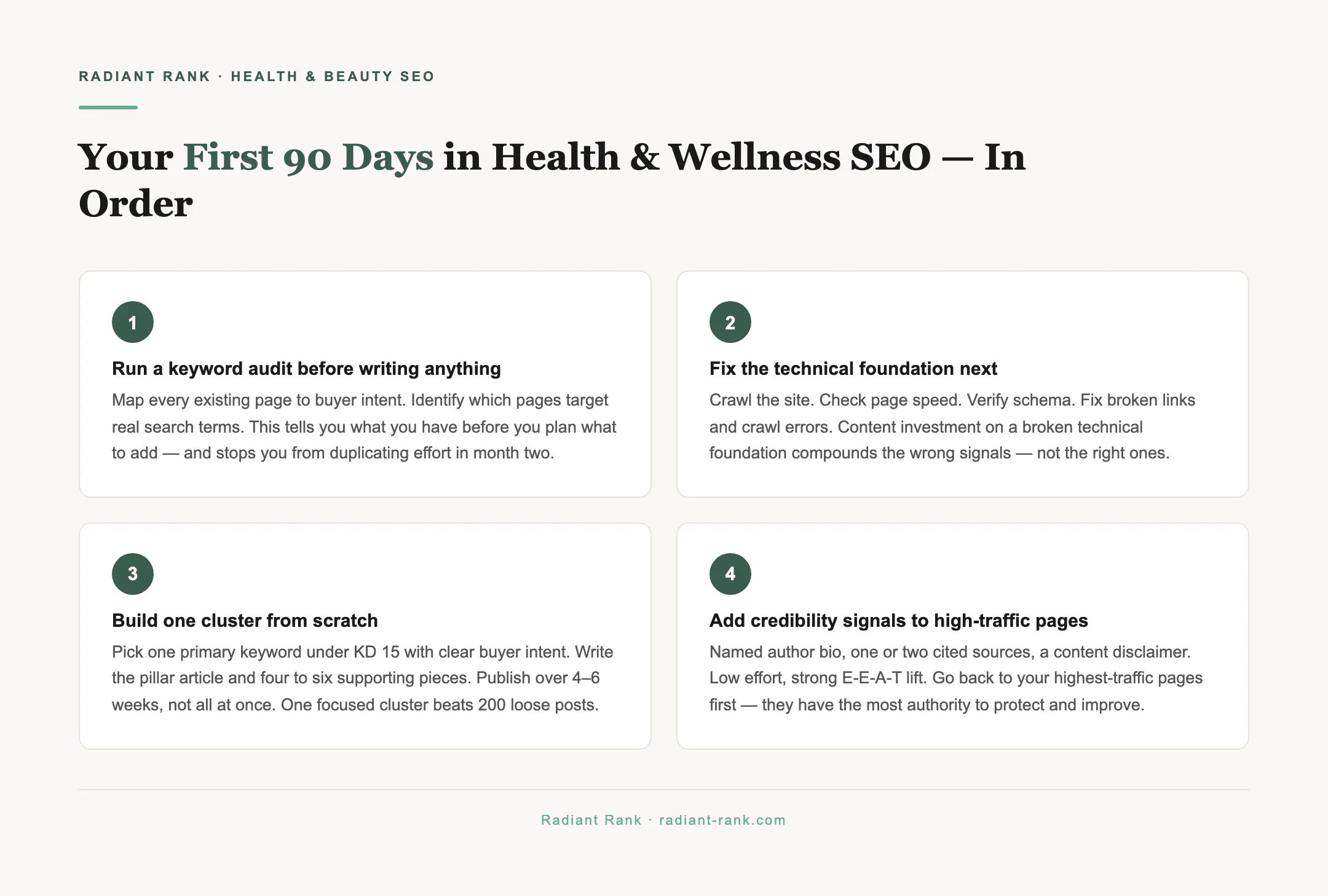
Your first 90 days: where to start
The order matters. These are the four things to do first, in this sequence.
Start with a keyword audit. Map your current content to buyer intent. Identify which pages target real search terms and which are not targeting anything specific. This tells you what you have before you plan what to add.
Fix the technical foundation. Run a crawl. Check page speed. Verify schema markup. Identify and fix broken links and crawl errors. Content investment on a broken technical foundation is wasted.
Build one cluster from scratch. Pick one primary keyword under KD 15 with clear buyer intent. Write the primary article and four to six supporting articles. Internally link them. Publish over four to six weeks, not all at once.
Add author and credibility signals to existing content. Go back to your highest-traffic pages. Add a named author bio, a source reference or two, and a content disclaimer. These are low-effort changes that move E-E-A-T signals without requiring new content.
By day 90, you should have a clean technical foundation, one functioning content cluster, and a keyword map that tells you exactly where to go next.
If you are ready to stop guessing and start building organic traffic that holds, RadiantRank specializes in wellness brand SEO for health companies that need to grow without burning budget on ads. We know this niche. We know the compliance boundaries. And we know which keywords move.