SEO for Wellness Apps: The Download Channel Nobody Talks About

Most wellness app founders treat SEO as an app store problem. They optimise their App Store title, tweak keywords in the Play Store listing, and call it done. Google search never enters the conversation.
That’s a missed channel. And it’s where most of your competitors aren’t looking.
App store algorithms vs Google search: the channel most wellness apps ignore
App store optimisation (ASO) and Google SEO are different systems. ASO influences your ranking inside the App Store or Play Store. Google SEO influences what shows up when someone types “best sleep app for insomnia” or “mindfulness app for anxiety” into a browser.
Those two searches have different intent. App store searches are browsing. Google searches are researching. The person on Google is comparing options, reading reviews, and clicking links before they ever open an app store.
That’s the gap most wellness apps miss entirely.
According to IQVIA’s Digital Health Trends report, there are over 350,000 health apps available across major app stores. Standing out inside a store with that volume is hard. Standing out in Google search is more tractable — especially in lower-competition wellness categories.
Why wellness apps need Google search visibility (not just app store ranking)
When someone hears about a wellness app from a podcast or friend, the first thing they do is Google it. What they find — or don’t find — determines whether they download it.
A bare App Store listing is a weak signal. A website with content, reviews, and clearly explained benefits is a strong one.
Google search also catches people earlier in their decision. A person searching “how to track my sleep better” hasn’t decided on an app yet. They’re open. If your content shows up there, you reach them before they’ve even started comparing options.
That’s a fundamentally different acquisition moment. And it compounds over time in a way that paid ads don’t.
The wellness app market is growing rapidly, but most growth strategies focus on paid installs, influencer partnerships, and app store ranking. Organic web search remains underused — which means lower competition and lower cost per acquired user for teams willing to invest in it.
Keyword research for wellness apps: problem keywords, category keywords, and comparison searches
SEO for wellness apps starts with understanding how your potential users search. There are three types of queries worth targeting.
Problem keywords match what someone is struggling with, not what they’re looking for. “How to sleep better with anxiety,” “breathing exercises for stress,” “why do I wake up at 3am.” These searches have no product intent yet — but they bring users into your orbit early.
Category keywords are closer to intent. “Best meditation app,” “sleep tracking app,” “habit tracking for wellness.” These people are actively comparing products. Landing pages and review coverage matter here.
Comparison searches are the highest-intent queries before the download. “Calm vs Headspace,” “best free mindfulness app,” “Oura alternative.” If your app is in a space with established players, appearing in comparison content is a direct path to installs.
For a practical overview of how to apply this to a broader content strategy, read the Health and Wellness SEO Guide.
Start with problem keywords. They’re lower competition, they build topical authority, and they attract the user before any other app does.
Building a web presence for your app: content, landing pages, and review coverage
Your web presence has three layers.
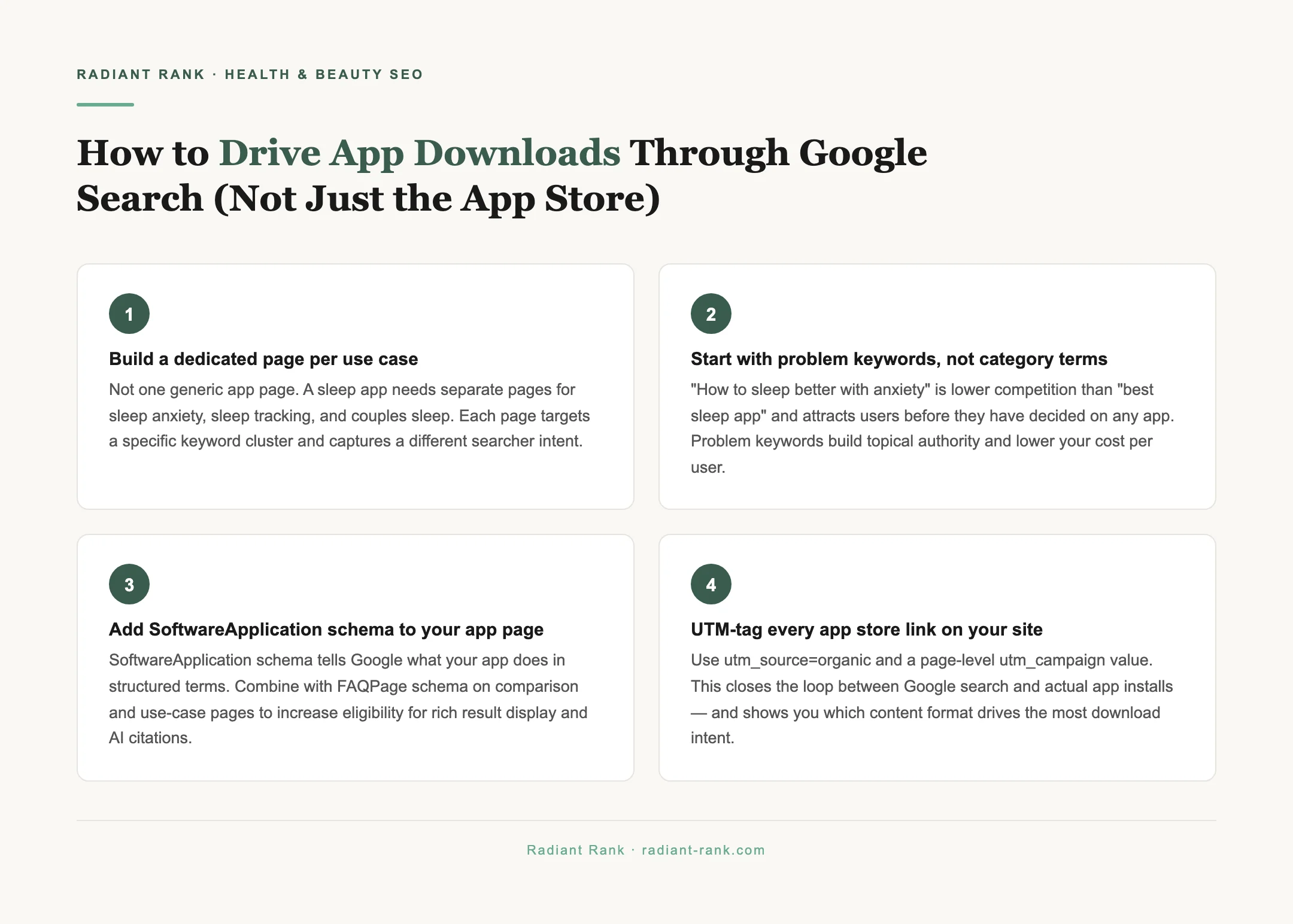
Landing pages are the foundation. You need at least one page per major use case — not a single generic page about the app. A sleep app should have a dedicated page for sleep anxiety, one for sleep tracking, one for couples sleep schedules. Each page targets a specific cluster of keywords.
Content builds authority over time. Blog posts answering problem keywords signal to Google that your site is a genuine resource in this niche. Ten well-targeted articles published over three months outperform one thin product page with no supporting content.
Review coverage is the third layer. When a third-party site publishes a review of your app and links back to your website, that’s a trust signal Google weighs in your favour. Reach out to wellness bloggers, health tech journalists, and app review sites early. Don’t wait for installs to accumulate before seeking coverage.
For a broader view of what this looks like in practice, see our notes on health platform SEO.
Technical SEO prep before launch: URL structure, schema, site speed
Before you publish anything, the technical foundations need to be right. Fixing these after launch is slower and more disruptive.
URL structure should be clean and keyword-relevant. /sleep-tracking-app/ is better than /features/?id=7. Every major use case or content category should have its own clean URL.
Schema markup tells Google what your pages are about in structured terms. For a wellness app, the most useful schema types are SoftwareApplication (for your app landing page), Article (for blog content), and FAQPage (for FAQ sections). Google’s Search Central documentation covers the full schema specification.
Site speed matters more for apps than for most product types. Your users are mobile-first. If your website loads in four seconds on mobile, you’ve already lost a portion of your potential installs. Use Google PageSpeed Insights to identify and fix bottlenecks before you push to production.
Post-launch: measuring web-driven app downloads from organic search
Most wellness app teams set up GA4 and stop there. That’s not enough to close the loop between Google search and app installs.
Here’s the minimal tracking setup that works.
Add UTM parameters to every app store link on your website. Use utm_source=organic, utm_medium=web, and a utm_campaign value specific to the page (e.g. sleep-landing). This lets GA4 attribute store link clicks to the organic channel rather than lumping them into direct traffic.
Inside Apple App Store Connect and Google Play Console, check the Acquisition reports. Both platforms show “web referral” as a traffic source when someone arrives from an external website. Cross-reference this with your GA4 data to get a fuller picture.
Set up a GA4 event for app store link clicks. Name it something descriptive like app_install_intent. Track it as a key event. Over time, this becomes your primary conversion metric for the organic web channel.
Review this data monthly. Look for which pages drive the most clicks to the app store, and double down on that content format or topic cluster.
Where to go next
Wellness app SEO is more tractable than most founders expect. The channel is underused, the competition is lower than in paid search, and the compounding effect of organic content means installs grow without proportional budget increases.
If you want to build this properly before launch — keyword strategy, landing page architecture, schema setup, content plan — RadiantRank specialises in health and wellness SEO. We work with wellness app teams who want a web presence that pulls in users from Google, not just the app store.
FAQs
Can I rank a wellness app in Google search results? Yes. Google indexes app landing pages, review sites, and comparison articles that rank for queries like “best meditation app” or “sleep tracking app for anxiety.” If your app has a web presence with optimised pages, you can appear in those results and drive installs from search.
Do I need a website for my app to rank on Google? Yes. Without a website, Google has nothing to index. App store listings do not rank reliably in Google search. A purpose-built landing page with the right keywords, schema, and content gives you a crawlable, indexable web presence that can drive installs over time.
How do I measure app downloads from organic search? Set up UTM parameters on your app store links from your website (e.g. utm_source=organic, utm_medium=web). Use Google Analytics 4 to track clicks on those links. Cross-reference with Apple App Store Connect and Google Play Console acquisition reports, which show “web referral” as a traffic source.