Beauty Brand SEO Agency: What to Expect and How to Choose

Most wellness brands know they need SEO. They have tried it — hired a freelancer, signed with an agency, published a few blog posts with no keyword strategy. Nothing happened. So they went back to ads.
The problem usually is not the tactic. It is the fit. Beauty SEO is not the same as general SEO. The search behavior is different. The compliance risks are different. The content strategy is different.
This post walks through what a beauty brand SEO agency actually does, when hiring one makes financial sense, and how to tell the good ones apart.
How Beauty Brand Buyers Search
Beauty shoppers do not search the way most people assume. They rarely start with brand names. They start with problems.
“best moisturizer for hormonal acne.” “niacinamide vs retinol for hyperpigmentation.” “fragrance-free SPF that does not pill under makeup.”
This is ingredient-led, skin concern-led, and comparison-driven search behavior. Statista reports that global beauty and personal care ecommerce revenue is projected to exceed $750 billion by 2030. That volume of demand runs through search — and most of it starts with a symptom, not a brand.
The implication for SEO: your content needs to match how buyers think, not how you talk about your products. A brand writing about “our innovative hydration formula” will not rank for “hyaluronic acid serum for dry skin.” Those are different documents serving different searches.
Generalist SEO agencies miss this. They do keyword research without understanding ingredient stacks, skin types, or how beauty buyers compare products at the decision stage. A specialist beauty SEO agency starts by mapping the actual search behavior in your category — then builds content that intercepts it.
Why DIY Beauty SEO Fails
DIY beauty SEO tends to stall for three reasons.
Topical authority takes time to build. Google does not rank a single good blog post. It ranks sites that have demonstrated expertise across a topic cluster. For a beauty brand, that means publishing interconnected content on skincare ingredients, formulation concerns, routine advice, and product comparisons — consistently, over months. Most brands publish five posts and stop.
FTC compliance adds complexity. The FTC’s guidelines on cosmetic and beauty claims require that marketing claims be substantiated. If your SEO content makes efficacy claims — “reduces wrinkles by 30%” — without proper backing, you carry legal risk. A specialist agency builds content that ranks without crossing into unsubstantiated territory. A generalist agency typically does not know the line exists.
Google treats health and beauty as higher-stakes content. Google’s quality rater guidelines treat health and beauty content with elevated scrutiny. Content that touches skin health, wellness, or body-related concerns is evaluated for expertise, authoritativeness, and trustworthiness. Thin or poorly sourced content in this category gets suppressed. The standard is higher than it is for, say, a software blog.
DIY teams rarely have the bandwidth or the subject knowledge to maintain the output quality this requires.
What a Beauty-Focused SEO Agency Does Differently
A generalist SEO agency will do keyword research, produce content, and build links. A beauty-focused agency does the same things — with a layer of category knowledge that changes the output.
Here is what that looks like in practice.
Keyword research accounts for ingredient and concern clusters. Instead of targeting “face serum,” a specialist finds “niacinamide serum for oily skin” (high intent, low competition) and builds a content cluster around it. They understand which ingredients are trending, which concerns are underserved, and where the comparison searches happen.
Content is written for someone who knows the category. A beauty buyer reading “hyaluronic acid vs glycerin” knows both terms. Content that over-explains loses them. Content that assumes no knowledge sounds generic. A specialist agency writes at the right level of depth.
FTC-aware content strategy. Claims are framed around what the formulation does — not what results it guarantees. This is not just legal hygiene. It builds trust with readers who are increasingly skeptical of overclaiming beauty brands.
Link building in the right vertical. A generalist may secure links from lifestyle blogs. A specialist targets beauty editors, ingredient-focused wellness publications, and skincare communities where links carry actual topical authority signal.
This is why beauty brand SEO is a distinct service area — not a subset of general digital marketing.
When an Agency Makes Sense: The Cost-Benefit Reality
Hiring a beauty SEO agency is not the right move for every brand at every stage.
It makes sense when you have a product that is already selling — through DTC, retail, or both — and you want to reduce your dependence on paid acquisition. SEO compounds over time. A page that ranks costs you nothing to maintain once it is ranking. An ad campaign stops the moment you stop paying.
It makes sense when your average order value or repeat purchase rate is high enough to justify the retainer. If a customer is worth $300 over their lifetime, acquiring them through SEO at a fraction of paid acquisition costs is a clear win. If your AOV is $18 and you sell once, the math is harder.
It does not make sense for pre-product brands. SEO is a medium-term channel. If you are still validating whether anyone wants what you sell, SEO is not where your budget should go.
The sweet spot is brands doing $300K to $5M in annual revenue — established enough to invest in a slower channel, but not yet large enough to afford the agency retainers that top-tier firms charge.
For a fuller view of how SEO strategy fits into the health and wellness category, the Health and Wellness SEO Guide covers the full picture.
How to Evaluate a Beauty SEO Agency: The Right Questions to Ask
Most agencies look credible on a website. The evaluation happens in the conversation.
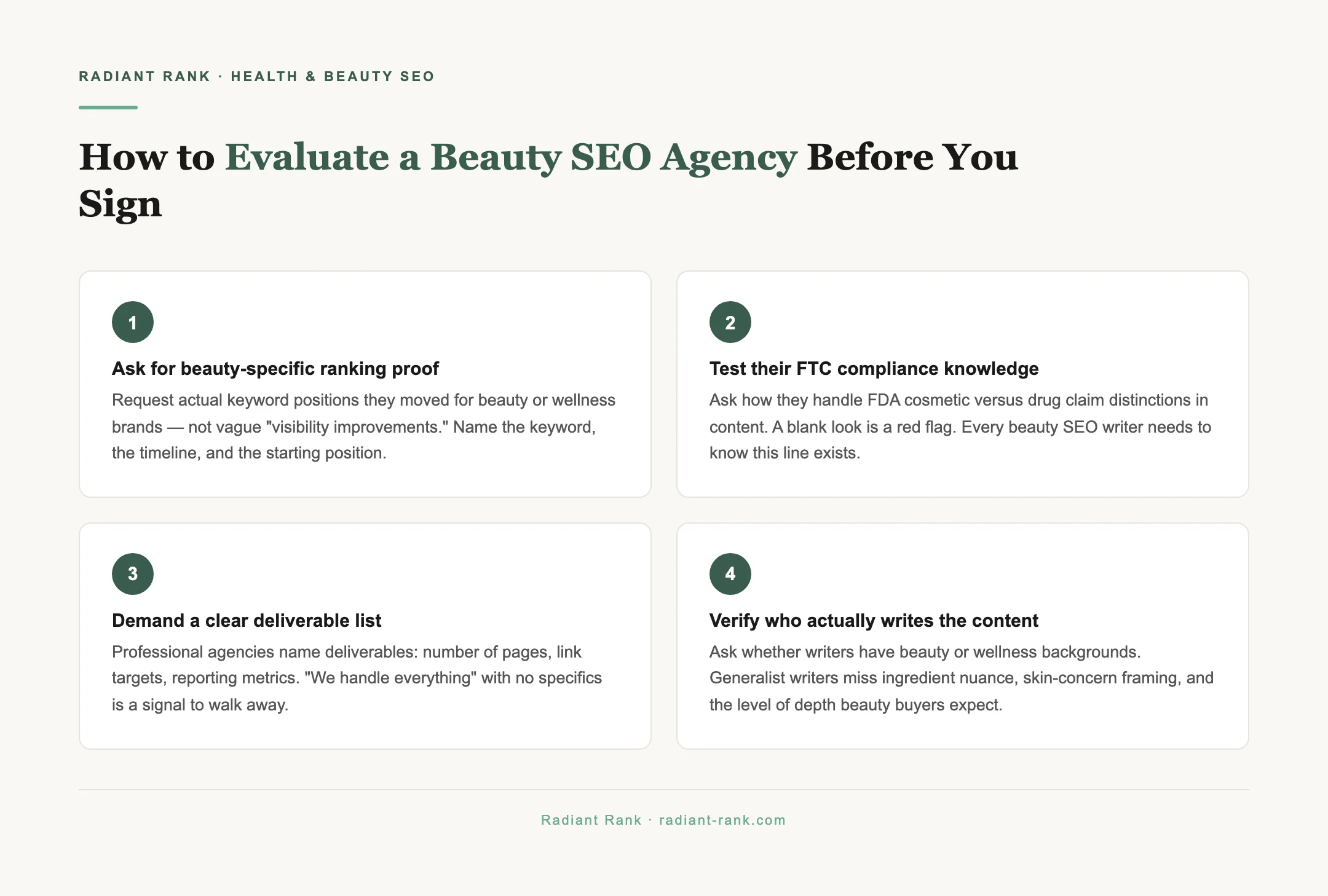
Ask to see beauty-specific results. Not general client wins — rankings they have moved for a beauty or wellness brand. Ask what keywords, what timeline, what starting position. Vague answers about “visibility improvements” are not results.
Ask how they handle FTC compliance. If they look confused, they have not thought about it. This is a red flag for any agency writing health or beauty content.
Ask what their keyword selection process looks like. Good agencies will explain how they identify low-competition, high-intent terms. They will talk about search intent, not just search volume. If their process is “we use Ahrefs and find high-volume keywords,” that is insufficient for a niche category.
Ask what you receive each month. A clear deliverable list — number of pages, reporting metrics, link targets — signals a professional operation. “We handle everything” with no specifics signals the opposite.
Ask who writes the content. Beauty SEO content written by a generalist writer without category knowledge will miss. Ask whether writers have beauty or wellness backgrounds. Ask to see samples.
Ask what happens in month three if rankings have not moved. Every agency will tell you SEO takes time. The good ones can explain what early indicators they watch — crawl status, indexation, click-through rates — and what they adjust based on those signals.
What to Expect: Timeline, First Results, Ongoing Optimization
Here is a realistic picture of how the first several months unfold.
Month one is research and foundation. A good agency spends this time auditing your existing site, mapping your keyword clusters, identifying technical issues, and planning the content calendar. You should receive a clear plan by the end of the month.
Months two and three are content production and on-page optimization. New pages go live. Existing pages get updated. Technical issues get fixed. You will not see significant ranking movement yet — this is normal.
Months three to five is when early signals appear. Low-competition keywords begin to rank. Traffic from long-tail searches starts to grow. The agency should be showing you these signals clearly — not hiding behind “SEO takes time.”
Months six and beyond is when compounding begins. Topical authority builds. Interlinked content clusters reinforce each other. Inbound links accumulate. This is where SEO starts to outperform paid acquisition on a cost-per-acquisition basis.
The brands that get the most from this channel publish consistently, share market knowledge with their agency, and treat SEO as a long-term asset — not a campaign.
If you are evaluating whether specialist SEO is the right move for your beauty brand, the beauty brand SEO service page covers how RadiantRank approaches this category specifically. Or start with the health and wellness SEO overview to understand how the broader strategy fits together.
Frequently Asked Questions
How much does a beauty brand SEO agency cost?
Most specialist beauty SEO agencies charge between $750 and $2,500 per month depending on the scope of work and the age of your domain. Newer domains typically require more foundational work, which reflects in the price. Avoid agencies that charge by the hour — monthly retainers align incentives better.
How long does it take to rank for beauty brand keywords?
Low-competition beauty keywords (KD under 20) can surface in search results within 2 to 4 months on a new domain. Mid-competition terms take longer — typically 6 to 9 months. The speed depends on your domain authority, the quality of the content, and how consistently new pages are published.
What questions should I ask before hiring a beauty SEO agency?
Ask to see rankings they have achieved for other beauty or wellness clients. Ask how they handle FTC compliance in content. Ask what their keyword selection process looks like. Ask what deliverables you receive each month. If they cannot answer these clearly, move on.