Wellness SEO Services: What They Cover and How to Choose

Most wellness brands know they need SEO. They’ve tried it: hired a freelancer, signed with an agency, published a few blog posts with no keyword strategy. Nothing happened. So they went back to ads.
The problem usually isn’t SEO. It’s that the service they bought wasn’t built for wellness.
This guide covers what wellness SEO services include, how provider types compare, what pricing looks like, and what to watch out for.
What wellness SEO services cover
Wellness SEO services include keyword research targeting health and supplement buyer intent, technical site fixes, content production to build topical authority, and link acquisition to build domain credibility. All delivered on a monthly cadence that builds on itself over time.
That’s the core. Here is what each piece involves in practice.
Technical SEO. Your site needs to be crawlable, fast, and structured correctly before content work matters. This means fixing crawl errors, improving Core Web Vitals, and ensuring structured data is in place. Moz’s SEO learning resources explain the technical foundations well for non-specialists.
Content production. Good wellness SEO content targets specific buyer intent keywords: “best magnesium for sleep”, “ashwagandha benefits evidence”, “clean protein powder brands”. Not generic wellness topics. Each piece needs to be accurate, credible, and written with E-E-A-T signals in mind (experience, expertise, authoritativeness, trustworthiness).
Authority building. Other sites linking to yours tells search engines your content is worth ranking. In wellness, this usually means earning coverage in health publications and nutrition sites. It’s slow work. The right kind of slow.
Ongoing optimisation. Rankings shift. Search intent changes. Monthly work includes refreshing existing content, monitoring keyword positions, and identifying new cluster opportunities.
For a full breakdown of how these pieces fit together for health brands, the Health and Wellness SEO Guide covers the strategy layer in depth.
Why wellness SEO is different from standard SEO services
Wellness content sits in what search engines classify as YMYL (Your Money or Your Life). Search engines apply stricter quality signals to YMYL content than they do to, say, a blog post about furniture.
That has practical consequences.
Author credentials matter. An article about sleep supplements written by someone with verifiable nutrition credentials will outperform the same article written anonymously. Generalist agencies rarely think about this.
FTC compliance matters. Supplement and wellness brands operate under FTC regulations on health claims. Content that crosses that line is a legal risk and an SEO risk. Google has gotten better at detecting prohibited claims.
Wellness buyers also research heavily before purchasing. They compare ingredients, look for testing data, and read reviews. SEO for wellness brands needs to match that behaviour, not just target transactional keywords.
A generalist agency applies the same playbook to a wellness brand that they use for a roofing company. That’s why nothing moves.
HubSpot’s research on organic search shows organic drives the highest traffic volume across industries. In wellness, where paid channels face increasing health claim restrictions, organic ranking is more valuable, not less.
DIY vs freelancer vs generalist agency vs wellness specialist: the honest tradeoffs
DIY. Realistic if you have time and are willing to learn. Tools like Ahrefs or Semrush run $100 to $200 per month. You’ll move slowly. Worth it if budget is zero and you can commit 8+ hours per month.
Freelancer. Typically $500 to $1,200 per month. Good ones exist, but vetting is hard. A freelancer who genuinely knows wellness SEO is rare. Ask for wellness-specific case studies before hiring.
Generalist agency. Higher budget, $1,500 to $5,000 per month and up. More process. Not necessarily better results for a wellness brand. If they don’t have wellness-specific experience, you’re paying for a process that wasn’t built for your niche.
Wellness specialist. Higher cost than a freelancer, lower than a large generalist agency. Every decision, from keyword selection to compliance review, is made with wellness buyer behaviour in mind. The gap between a generalist and a specialist widens the more YMYL-sensitive your product category is.
Red flags: what NOT to buy from an SEO service
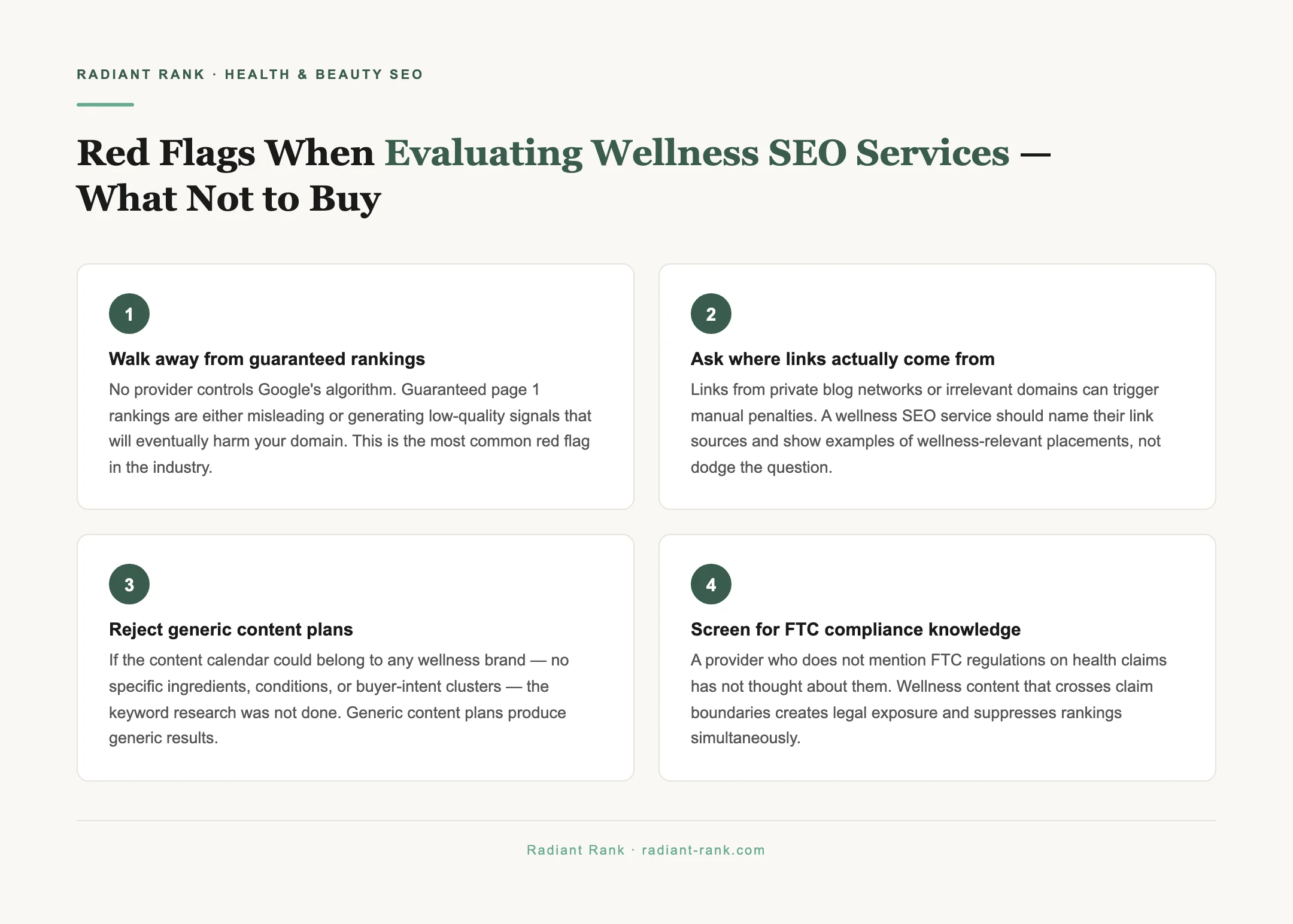
Guaranteed rankings. No one controls Google’s algorithm. Any provider offering a page 1 guarantee is either misleading you or generating low-quality signals that will eventually harm your site.
Links from unknown sources. Links from private blog networks or irrelevant sites can trigger penalties. Ask specifically where links come from.
Month 1 results. A provider promising quick wins is overpromising. Expect first ranking movement in weeks 6 to 10.
Generic content plans. If the content calendar could belong to any wellness brand, the keyword research hasn’t been done.
No mention of compliance. A provider who doesn’t mention FTC guidelines hasn’t thought about them.
Pricing models: retainer vs project vs performance-based
Retainer. The standard model. You pay a fixed monthly fee for a defined scope of work. This is the most predictable arrangement for both sides. Typical range for wellness-specialist work: $750 to $2,000 per month depending on content volume and site size.
Project-based. A fixed fee for a one-time deliverable: a technical audit, a keyword strategy, or a content sprint. Useful for brands that want to validate an approach before committing to a retainer. Expect $500 to $3,000 depending on scope.
Performance-based. You pay based on ranking or traffic outcomes. Sounds appealing. In practice, it creates perverse incentives. Providers optimise for metrics they can control (keyword positions for easy, low-value terms) rather than outcomes you actually care about (qualified traffic and leads). Approach with caution.
Most wellness brands are best served by a retainer once they’ve validated that the provider understands their niche. A project engagement first is a reasonable way to test that.
Realistic expectations: timeline, first wins, long-term ROI
SEO timelines are variable. They depend on your domain’s age, current authority, competition level in your specific keyword cluster, and how consistently work gets done.
That said, here is a realistic pattern for a wellness brand starting from zero.
Weeks 1 to 4. Technical fixes applied. Keyword strategy finalised. Content in production. No ranking movement yet.
Weeks 6 to 10. First rankings on Tier 1 cluster keywords, usually positions 20 to 40. Traffic is minimal but confirms the strategy is working.
Months 3 to 4. Multiple pages ranking. Some Tier 1 keywords moving toward page 1. Traffic growing.
Months 5 to 6. Page 1 rankings on primary cluster keywords for most brands. Organic becoming a consistent acquisition channel.
Month 12 and beyond. Compounding returns. Content from months 1 to 6 is still generating traffic. Cost-per-lead from organic drops well below paid channels.
Organic leads in health and wellness consistently outperform paid leads on conversion rate. Buyers who find you through search are already in evaluation mode. They searched, they read, they chose.
The brands that see the strongest ROI are the ones that start early, before they need it, and stay consistent. SEO is not a rescue strategy for a revenue shortfall. It’s infrastructure.
If you’re evaluating wellness SEO services, the first step is understanding what your niche looks like from a keyword and competition standpoint before committing to any provider.
We work with wellness brands across three areas: wellness brand SEO for D2C supplement companies, wellness app SEO for digital health and fitness tools, and beauty brand SEO for skincare brands navigating YMYL and FTC compliance. The Health and Wellness SEO Guide covers the full strategy layer.
For the same evaluation framework applied to beauty brands, this overview of beauty brand SEO agencies is a useful starting point.