Beauty SEO Company: How to Choose One That Understands Your Niche

A beauty SEO company is the operational fit for your brand if it understands FDA claim restrictions, ingredient-driven keyword research, and the social-to-search overlap unique to beauty buyers. Most “beauty SEO companies” are general digital agencies with a beauty service page. The difference matters.
Why “beauty SEO company” usually doesn’t mean specialist
Search “beauty SEO company” and most of the top results are general digital agencies with a service page targeting the keyword. They serve dental, legal, plumbing, and beauty from the same playbook. The beauty-specific page borrows language from beauty marketing blogs and adds it to a generic agency template.
That works for the SERP. It doesn’t work for your brand.
Beauty and wellness have a regulatory layer most niches don’t. The FDA’s framework on cosmetic vs drug claims draws a line: claims like “smooths fine lines” are usually fine, claims like “prevents wrinkles” can reclassify your product as a drug, triggering different compliance requirements. A general agency optimising for “best wrinkle treatment” doesn’t know they just exposed your brand to enforcement risk.
That’s only one piece. Beauty buyers also search differently than buyers in other niches: ingredient names (“retinol,” “niacinamide,” “hyaluronic acid”) get more search volume than category terms in some cases, and the social-to-search journey (TikTok discovery → Google validation) is more pronounced than in non-beauty ecommerce.
In our experience auditing beauty and wellness sites, we see the same pattern: the previous agency wrote keyword-rich product copy that risks claim issues, missed ingredient-driven content opportunities entirely, and treated social and search as separate channels when beauty buyers move between them in the same purchase journey.
What a real beauty SEO company does differently
Five operational differences separate a specialist from a generalist with a beauty service page.
1. Claim-aware copywriting. Every product page, blog post, and meta description gets reviewed against the FDA cosmetic vs drug claim framework. The specialist knows which language triggers reclassification, writes within the cosmetic framework, and still produces copy that ranks. This is not slower content. It is content that won’t get pulled down later.
2. Ingredient-driven keyword strategy. Beauty buyers search “vitamin C serum for sensitive skin” and “fragrance-free moisturizer for rosacea” more than they search “best skincare brand.” A specialist builds keyword clusters around ingredients, skin concerns, and benefit-without-claim language. A generalist runs a keyword research tool, exports the top-volume terms, and ignores the ingredient layer.
3. Before-and-after content handling. Before-and-after photography drives conversion in beauty. It also creates compliance and Google policy issues if handled wrong (testimonials need disclosure language, results pages need timeline framing, model dimensions need disclosure). A specialist knows the patterns. A generalist publishes whatever the brand sends and creates exposure later.
4. Social-to-search funnel awareness. Beauty buyers discover on Instagram and TikTok, then validate on Google. The validation searches are specific: “[brand name] reviews,” “[brand name] vs [competitor],” “is [product] worth it.” A specialist builds content for these mid-funnel queries. A generalist treats social and search as separate channels and misses the bridge.
5. Influencer and PR integration. Beauty brands rely on influencer-led launches and PR coverage that earn natural backlinks. A specialist coordinates with whoever runs your influencer program to capture link equity from coverage. A generalist treats backlinks as a separate “link building” line item disconnected from the brand’s actual PR motion.
We covered the agency-vs-company hiring question separately in our beauty brand SEO agency guide. This piece is about the operational structure underneath.
Red flags when evaluating a beauty SEO company
| Red flag | Why it matters |
|---|---|
| Their service page lists 15+ industries | Beauty is a tab, not a specialty |
| Pricing requires a discovery call | Price will be set based on what they think you can pay |
| They can’t name the FDA cosmetic vs drug claim distinction | They will write copy that creates compliance exposure |
| Their portfolio shows zero beauty or wellness brands | They are learning beauty on your account |
| They pitch SEO separately from your influencer and PR work | They will miss the link equity those channels generate |
What to ask in the first conversation
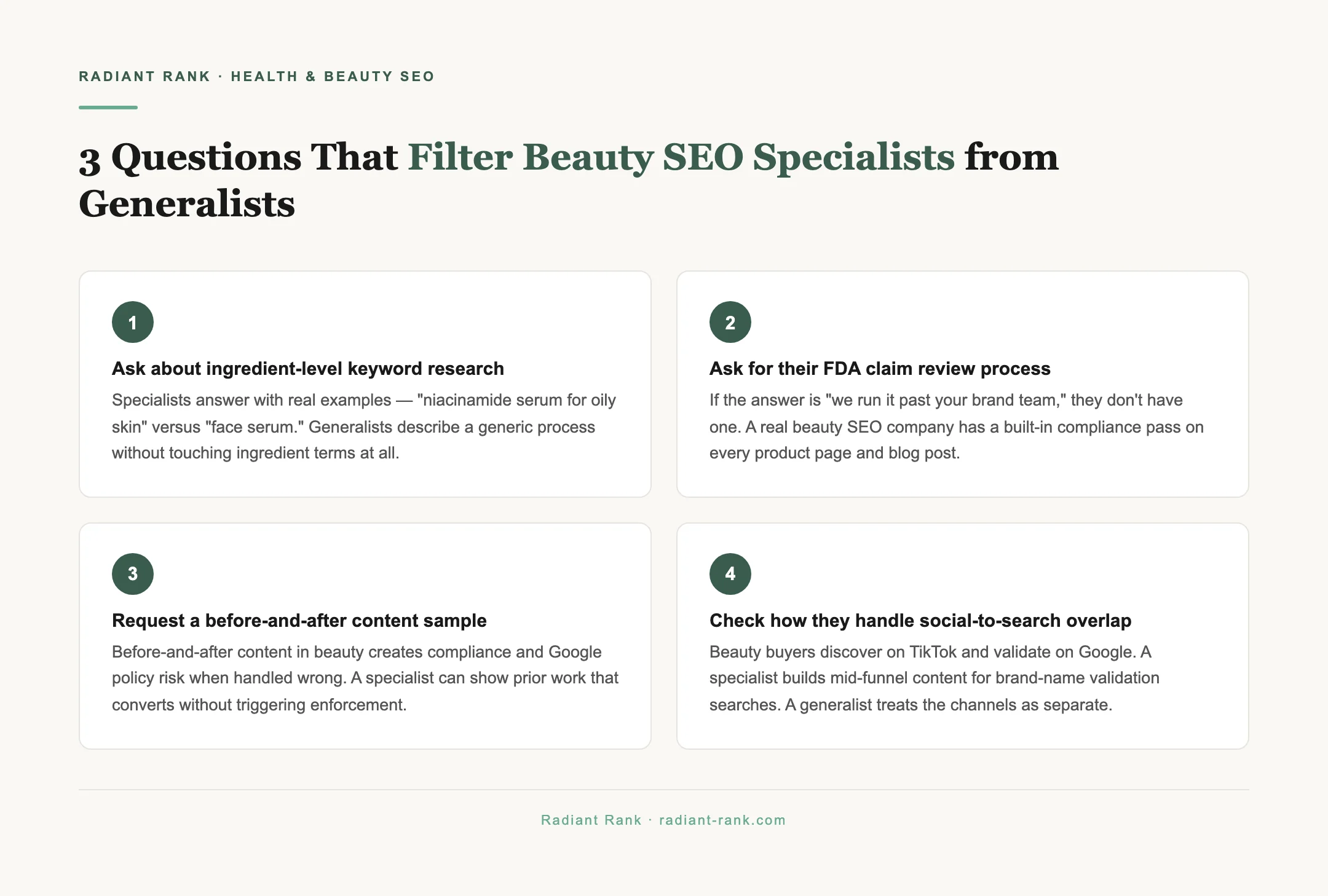
Three questions that filter generalists from specialists in 10 minutes:
- “How do you handle ingredient-level keyword research vs category-level?” Specialists answer with examples. Generalists answer with general process descriptions.
- “What’s your process for FDA claim review on product copy?” If the answer is “we run it past your brand team,” they don’t have one.
- “Show me a before-and-after content piece you’ve written for a previous client.” If they hesitate, the prior portfolio either doesn’t exist or used patterns that wouldn’t pass a current Google review.
A specialist answers all three with specifics. If the answers stay general, the work will be too.
How RadiantRank works
RadiantRank is the productized SEO retainer for beauty, skincare, and wellness brands. Pricing is $750/month, published on the homepage with no discovery call required. Every engagement starts with a claim-language audit and ingredient-keyword mapping before content production starts. The full scope is in the health and wellness SEO guide.
FAQ
What does a beauty SEO company actually do? A specialist beauty SEO company builds organic search visibility for beauty and wellness brands while staying within FDA claim restrictions, optimises product pages around ingredient and benefit queries, manages before-and-after content carefully, and integrates with the social and influencer channels beauty brands already use. Most general agencies do none of this.
How is a beauty SEO company different from a general digital agency? A general digital agency treats beauty as one of many service pages and applies the same playbook to every client. A specialist beauty SEO company understands the regulatory environment, knows how to write copy that converts without making restricted claims, and builds keyword strategies around ingredient and benefit terms that beauty buyers actually search.
How much does a beauty SEO company cost? Specialist beauty SEO ranges from $750/month (productized, published pricing) to $5,000/month (traditional beauty agencies). Mid-range $1,500-$3,000/month is most common. Many beauty agencies bundle SEO with influencer outreach and PR, which can hide what you’re paying for SEO specifically. Productized models separate the line items.
Why don’t most beauty SEO companies handle FDA claim language correctly? Most agencies don’t have a compliance lens. They write copy that ranks but exposes the brand to FDA enforcement risk on cosmetic vs drug claim distinctions. A beauty-specialist company writes copy that ranks AND stays within the cosmetic claims framework, knowing which language triggers regulatory attention.
If you’re evaluating beauty SEO companies and need a second opinion, see if RadiantRank is the right structural fit.